Becoming a Dad
This LGBT+ History Month, we’re highlighting the stories that are often overlooked.
Ryan, Proud 2 b Parents’ new Outreach and Partnership Worker, shares his journey of becoming a dad — a story that sits firmly within LGBTQ+ history.
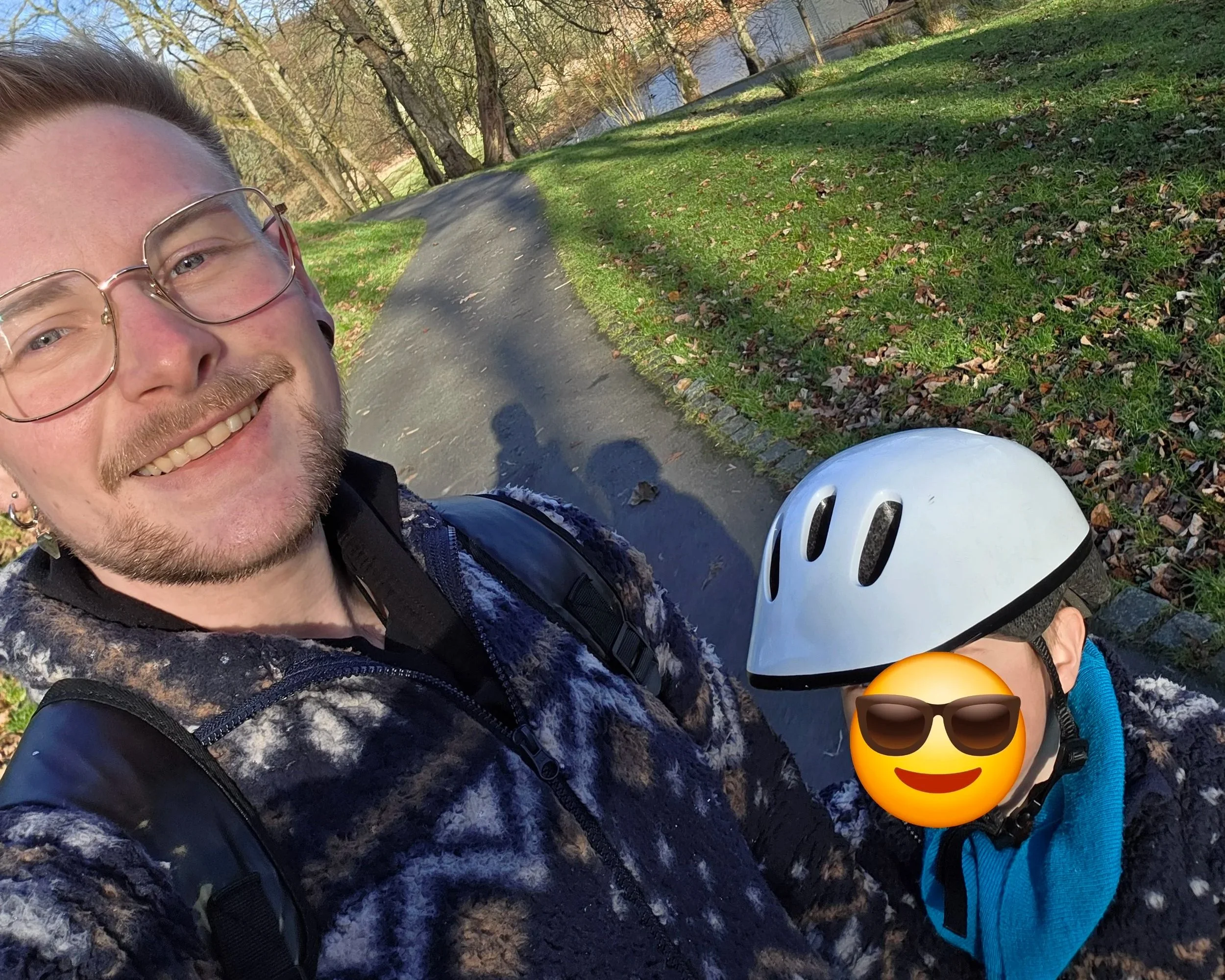
For as long as I can remember, I wanted children. That desire existed long before I had the language to understand myself as queer, and even longer before I knew I was a trans man. Parenthood always felt like part of my future—it just took time, courage, and a lot of self-discovery to understand what that future might look like.
When I first came out as bisexual, I still assumed I would eventually carry and birth a child. But at nineteen, after nearly two years of quiet, exhausting contemplation that kept me awake at night, I came out as transgender. One of my biggest fears at the time was that transitioning would mean giving up the possibility of having a biological child. I wrestled over the idea of delaying my medical transition—telling myself I could wait until I was married and I’d had children—all the while my crippling dysphoria tore me apart from the inside. Eventually, I realised that survival had to come first. I needed to transition, regardless of what it might mean for parenthood.
““One of my biggest fears was that transitioning would mean giving up the possibility of having a biological child.””
Like many people, I had been told that taking testosterone would make me infertile. So, I began imagining other ways of building a family. Adoption and fostering have always felt deeply meaningful to me—there are so many children in the world who deserve love, stability, and care. This is something I still hope to get the chance to do in the future. At nineteen, though, the practical barriers felt enormous. The requirements—space, stability, finances—made it seem like something I definitely wouldn’t be able to do until much later in life.
Then, in January 2019, ten weeks after starting testosterone, I found out I was pregnant with my son.
It was something I genuinely didn’t think was possible.
At twenty-one, my life didn’t look like the ideal picture of “ready for parenthood.” I had recently separated from my son’s other parent, I was working my notice period, and I had moved back in with my mum and dad. But despite the fear and uncertainty, something inside me told me I needed to have him. Alongside that was the very real worry that this might be my only chance to have a biological child before hormones changed my fertility forever (something I now know is not true, as many trans masculine and non binary folks have come off testosterone in order to concieve, after many years of HRT).
““Despite the fear and uncertainty, something inside me told me I needed to have him.””
Pregnancy came with its own hurdles. At one point, my blood tests were thrown away because they had been submitted under a male name—the lab assumed they must have been sent incorrectly. That moment, frustrating as it was, led to a change in NHS Pennine guidance so that maternal bloods sent under a male name would still be processed. For much of my pregnancy, midwives delayed putting me onto the system because the technology simply didn’t allow for a pregnant man. They hoped it would catch up in time. Unfortunately, as it neared the end of my pregnancy, they apologised and told me they would have to register me as female, because that level of change often takes a long time with the way the NHS is set up.
It hurt. In such a modern world, it felt devastating that something as simple as adding an extra box on a form could spare trans parents so much distress.
After my son was born, I was required to register his birth within a set time frame. When I did, I was told I had to be listed as “mother” on his birth certificate because I was the one who gave birth. These moments didn’t erase the joy of becoming a parent, but they did leave marks—reminders of how often systems fail to recognise families that don’t fit a narrow template.
Even now, navigating everyday conversations can be tricky. When people learn that I have a son, they often ask about his “mum”—whether I get on with her, whether we’re still together. In those moments, I’m faced with a choice: out myself before I’m ready, or say that he doesn’t have a mum. The latter often leads to confusion or probing questions, typically well-intentioned, but still intrusive – something that most of us as LGBTQ+ parents will have experienced. It’s a delicate balance between protecting my privacy and managing other people’s expectations.
““It’s a delicate balance between protecting my privacy and managing other people’s expectations.””
Before I understood that I was transgender, I thought my unhappiness came from not being “girly” enough. My hair wasn’t long enough, the right colour, or styled the right way. I spent years forcing myself into a version of femininity I thought I should be, hoping that one day it would click. I wore makeup because I felt like I wouldn’t look right without it, while simultaneously feeling like I was playing a role that didn’t belong to me. Coming to terms with being trans meant unpacking a lot of internalised transphobia, and unlearning the idea that there’s only one way to be a man—or a trans man.
Parenthood has taught me just how human all of us are. No parent—dad, mum, papa, zizi, or however your little ones know you is perfect. Everyone is doing the best they can with what they have. The dad guilt is real. Whenever I’m not with my son, part of me feels like I should be. But I’m learning that taking breaks, working, and caring for myself are all part of caring for him too. It’s been hard, but it’s also been extraordinarily wonderful.
““Parenthood has taught me just how human all of us are.””
My son has completely changed how I see children. I’ve learned that one-year-olds are far more aware than I ever imagined, and that toddlers are fully conscious little people bursting with curiosity, emotion, and joy. His laughter, his wonder, and his growing understanding of the world remind me every day of how powerful love and guidance can be.
For a long time, I felt completely alone. During my pregnancy, I felt like an alien—like a spectacle. I worried about unwanted attention, about being rejected by the trans community for having a biological child. It wasn’t until my son was about four months old that I finally found the community I had been desperately searching for: other trans and non binary people who had given birth, or were planning to. Knowing I wasn’t alone changed everything, and finding Proud 2 b Parents, a vast community of LGBTQ+ people also experiencing their parenting and caring journey, that I could connect to and not feel quite as alone as I did before from it.
One of my greatest joys as a queer parent is the intention I bring to raising my child without assumptions. I won’t presume who he’ll love, what he’ll enjoy, or how he’ll express himself. Unicorns, trucks, dresses, muscles—none of it comes with rules in our house. I try to extend that same freedom to my nieces and nephews, encouraging curiosity and joy rather than limiting expectations.
More than anything, I want the children in my life to know that if they ever find themselves outside the cisgender, heteronormative box, they have a safe place with me. A place where they will be believed, supported, and loved unconditionally, as every child deserves to be.
Becoming a dad didn’t just give me a son—it gave me a deeper understanding of myself, of community, and of what it means to live authentically. And I wouldn’t change a single moment of it.